

Living in Orange
The City of Orange is in Orange County, near its center. The two share a name, but Orange is one city of about 26 square miles, bordered by Anaheim, Santa Ana, Tustin and Garden Grove. Two Los Angeles attorneys, Alfred Chapman and Andrew Glassell, held land along Santiago Creek and laid out a town they called Richland. The post office turned that name down in 1873, the town became Orange, and it incorporated on April 6, 1888.
Orange is the only city in the county planned around a plaza. The Plaza sits where Chapman Avenue crosses Glassell Street, and the square mile around it is Old Towne. The 55 freeway runs north to south through the middle of the city. West of it are the older flatland neighborhoods, the train station, and the junction of the 5, the 57 and the 22. East of it the land climbs toward the foothills, the regional parks and the 241 and 261 toll roads.
A few things inside the outline of Orange are not the City of Orange. Villa Park is a separate small city that Orange surrounds completely. Orange Park Acres, parts of El Modena and a small piece of Olive along Lincoln Avenue are unincorporated county land, where county rules and county services apply. Street addresses in Orange use five ZIP codes, 92865 through 92869.
Homes and property types in Orange
Orange has some of the oldest housing in the county. Old Towne, the square mile around the Plaza, was added to the National Register of Historic Places in 1997 and is the largest National Register district in California. Its houses are Victorian, Craftsman, California bungalow, hip roof cottage, Prairie, Mediterranean Revival and Spanish Colonial Revival, many of them more than a century old. They sit on a street grid with alleys, close to shops and Chapman University.
Outside Old Towne, most of the flatland was built as tract housing from the 1950s onward. The exception people ask about is the Eichlers. Joseph Eichler built three tracts here between 1960 and 1964, named Fairhaven, Fairmeadow and Fairhills, with post-and-beam houses, glass walls and atriums. The city made all three local historic districts in 2018, and exterior work on them has to follow the Orange Eichler Design Standards.
East Orange is newer. Santiago Hills was built from the mid-1980s, and Serrano Heights, on the hills next to Anaheim, around 2000. Both have homeowners associations. Orange also has mobile-home parks, some of them age-restricted to 55 and over, such as Orange Village on East Trenton Avenue and Santiago Creek Orange Estates on North Adele Lane.
Inspect for the era. A pre-1920 house in Old Towne is on a raised foundation and may still have early wiring, plaster walls and an unbraced chimney. An Eichler is on a slab, usually with the original radiant heat in the concrete and a flat or low-slope roof, so ask how each has been maintained or replaced. In the hillside tracts, look at drainage, slopes and whether the house sits in a mapped fire zone.
Orange neighborhoods and tracts
The city's own historic preservation pages name four areas with design rules: Old Towne, which is three overlapping historic districts, and the three Eichler tracts. Any change to the outside of a property in Old Towne must comply with the Historic Preservation Design Standards for Old Towne, and the city asks owners to talk to planning staff early. Elsewhere, an HOA rather than the city is usually what limits changes.
The names below are the ones used on listings and on city and county maps. Several are not in the city at all, which matters for permits, policing and who you call. Ask Tony to confirm the jurisdiction, any historic district and any homeowners association for the exact address before you offer.
- Old Towne
- About one square mile around the Plaza at Chapman Avenue and Glassell Street. Mostly pre-1940 houses. It contains the Plaza Historic District, listed in 1982, and the larger National Register district listed in 1997.
- Fairhaven (Eichler)
- The first Eichler tract, begun in 1960, in the southeast part of the city north of Fairhaven Avenue and west of Esplanade Street, along South Woodland Street. A local historic district since 2018.
- Fairmeadow (Eichler)
- Begun in 1962, west of the 55 along Cambridge Street just north of Taft Avenue, on streets including North Shaffer and East Glendale. A local historic district since 2018.
- Fairhills (Eichler)
- Begun in 1963, south of Katella Avenue and east of Hewes Street, along North Granada Drive and North Linda Vista Street. A local historic district since 2018.
- El Modena
- An older community around El Modena High School on the east side, founded in the 1880s among citrus groves. Part is inside the city and part is unincorporated county land.
- Olive
- One of the oldest settlements in the county, laid out as a town in 1887 along Lincoln Avenue on the north side. A small unincorporated piece remains, surrounded by the city.
- Orange Park Acres
- An unincorporated equestrian community on the east side, surrounded by the city, with large lots and fenced horse trails. County zoning applies. Founded in 1928.
- Santiago Hills
- A planned community at the east end of Chapman Avenue near Irvine Regional Park, built from the mid-1980s. Owners pay a city landscape maintenance assessment in addition to any association dues.
- Serrano Heights
- Hillside tracts in the northeast, next to Anaheim, built around 2000 under a specific plan. It has an HOA and sits inside City of Orange Community Facilities District No. 91-2.
Schools and district boundaries
Orange is served by the Orange Unified School District, formed in 1953 when the Orange, Olive, Villa Park, Silverado and El Modena elementary districts joined the Orange Union High School District. Today it also covers Villa Park and parts of Anaheim, Garden Grove and Santa Ana. Elementary schools generally run through sixth grade, middle schools are seventh and eighth, and high schools are ninth through twelfth.
The district has four comprehensive high schools, and only two are in the city. Orange High School is near Old Towne and El Modena High School is on the east side. Villa Park High School is in Villa Park, and Canyon High School is in Anaheim Hills. The attendance lines between them cut across Orange, so two houses with the same ZIP code can be assigned to different high schools.
Orange Unified also runs programs that enroll by application or lottery, including McPherson Magnet School and the Mandarin immersion program at Fletcher. Admission to those does not come with an address. Before you make an offer, confirm the assigned elementary, middle and high school for the address with the district.
- Orange Unified School District
- Kindergarten through twelfth grade. Unified on July 1, 1953. It serves Orange, Villa Park and parts of Anaheim, Garden Grove and Santa Ana, plus unincorporated areas such as Silverado.
- Orange High School
- Grades 9 to 12, in the center of the city. It opened in 1903 as Orange Union High School and is the oldest high school in the district.
- El Modena High School
- Grades 9 to 12, on the east side of Orange in the El Modena community. It opened in September 1966 and graduated its first class in 1968.
- Villa Park High School
- Grades 9 to 12, on Taft Avenue in the City of Villa Park. Built in 1964. Parts of Orange are inside its attendance area.
- Canyon High School
- Grades 9 to 12, in Anaheim Hills. It is an Orange Unified school even though it is in Anaheim. Confirm with the district whether an Orange address falls in its attendance area.
- McPherson Magnet School
- Kindergarten through eighth grade, in east Orange. A district math and science magnet that opened in 1997 and admits students through a lottery, not by attendance area.
- Fletcher Mandarin Language and GATE Academy
- Transitional kindergarten through sixth grade, on West Fletcher Avenue. It offers a Mandarin dual immersion program that continues at Cerro Villa Middle School and Villa Park High School.
- Cerro Villa, Portola and Yorba middle schools
- Grades 7 and 8. The district also has two charter middle schools, Santiago Charter in Orange and El Rancho Charter in Anaheim Hills.
What it costs to own here beyond the price
Under Proposition 13, a home is reassessed at its purchase price when it sells, and after that the taxable value can rise only by a small capped amount each year. In Orange, where many owners have held the same house for decades, the seller's tax bill is usually far below what yours will be. The county sends a supplemental bill after closing to make up the difference.
Most of Orange was built before Mello-Roos districts existed and has none. On the east side, the city formed Community Facilities District No. 91-2 for Serrano Heights, and a second city district, No. 06-1, appears in the county's Mello-Roos index. Santiago Hills owners pay into Landscape Maintenance Assessment Districts 86-2 and 15-1. Most east Orange tracts also have association dues. Ask Tony to pull the actual tax bill, because these charges sit on it line by line.
The City of Orange runs its own water system for most addresses, drawing about three quarters of its supply from city wells. Parts of the east side, including the Orange Park Acres area, are served by the Irvine Ranch Water District, and the East Orange County Water District serves some addresses as well. Trash, recycling and organics are collected by CR&R Environmental Services. Electricity is Southern California Edison and natural gas is Southern California Gas.
In May 2025 the city council took up an ordinance adopting the State Fire Marshal's Fire Hazard Severity Zone map for Orange. The mapped zones are on the east side near the foothills, where a 2007 fire burned through Santiago Oaks Regional Park. If an address is in a zone, the seller must disclose it and you should ask for an insurance quote early.
Parks, shopping and things to do
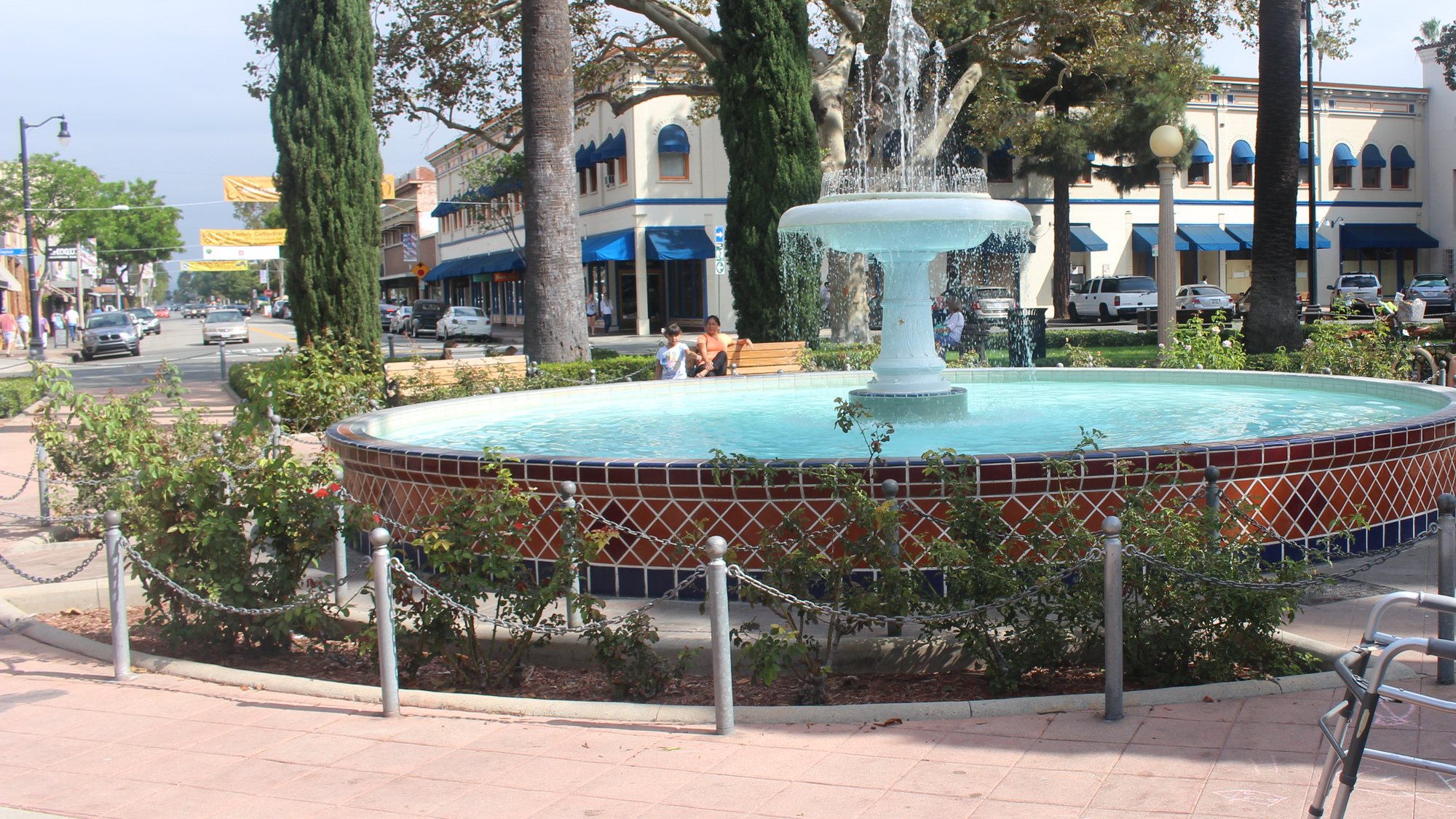
The Plaza is the center of town: a small park with a fountain at Chapman Avenue and Glassell Street, ringed by antique shops and restaurants, with Chapman University a few blocks north. The Orange International Street Fair has filled those streets every Labor Day weekend since 1973. The train station and the former Santa Fe depot are a short walk west of the Plaza.
The larger shopping centers are on the edges. The Outlets at Orange is on the west side near the 5 and the 22, and The Village at Orange is on Tustin Street on the north side. The east side has the open space: two county regional parks inside the city and Irvine Regional Park, with the Orange County Zoo, at the end of Chapman Avenue.
- Plaza Park
- The circle at Chapman Avenue and Glassell Street that the town was laid out around. The Plaza Historic District around it was listed in the National Register in 1982.
- Orange International Street Fair
- Held in the streets around the Plaza over Labor Day weekend every year since 1973, with food and music grouped by country.
- Hart Park
- The city's oldest park, on South Glassell Street along Santiago Creek at the south edge of Old Towne. It was built with the federal Works Progress Administration in the 1930s.
- Santiago Oaks Regional Park
- 1,269 acres of county parkland along Santiago Creek on North Windes Drive, with hiking, biking and equestrian trails, a nature center and a historic dam.
- Peters Canyon Regional Park
- 340 acres of county parkland on East Canyon View Avenue, with trails around the 55-acre Upper Peters Canyon Reservoir.
- Irvine Regional Park
- A county regional park at the east end of Chapman Avenue, next to Santiago Hills. It dates to 1897 and holds the Orange County Zoo.
Getting around and commuting
Orange sits on more freeways than most cities its size. The 5, the 57 and the 22 meet on the west side at the interchange known as the Orange Crush. The 55 runs north to south through the middle of the city. On the east side, the 241 and 261 are toll roads that head toward Irvine and south county, and they bill by FasTrak or license plate.
Orange station is at 194 North Atchison Street in Old Towne. Metrolink's Orange County Line and Inland Empire-Orange County Line both stop there, so it is a transfer point between trains toward Los Angeles, Oceanside, Riverside and San Bernardino. The station has a parking structure and a surface lot, and OC Bus routes connect to it. Amtrak's Pacific Surfliner stops one station north, in Anaheim.
Measured in a straight line from the Plaza, Disneyland is about 4 miles northwest, John Wayne Airport about 8 miles south, the Huntington Beach Pier and the Newport Pier each about 13 miles, and Los Angeles International Airport about 34 miles. Road miles are longer, and the freeway you take depends on which side of the 55 you start from.
Buying and selling in Orange
Tony Ayoub is a REALTOR and a licensed mortgage loan originator (NMLS ID 2359276). He has held a California real estate license since 2007 and speaks fluently in English and Arabic. These are the things to check in Orange, and Tony can go through each one with you.
Before you buy
- Confirm whether the address is inside the City of Orange. Orange Park Acres, parts of El Modena and a piece of Olive are unincorporated, and Villa Park is its own city, each with different rules.
- Read the Historic Preservation Design Standards before you buy in Old Towne, and the Orange Eichler Design Standards before you buy in Fairhaven, Fairmeadow or Fairhills. Exterior changes must comply with them.
- Ask whether the house has a Mills Act contract. The contract is recorded and passes to the buyer, and the city's page says it is not accepting new applications while the program is under review.
- Pull the tax bill for any east Orange address and read the special assessments. Serrano Heights is in a community facilities district, and Santiago Hills carries landscape maintenance assessments.
- Look up the address on the Fire Hazard Severity Zone map if the home is near the foothills, and get an insurance quote before you remove contingencies.
- Confirm the assigned high school with Orange Unified. Orange, El Modena, Villa Park and Canyon high schools all draw from parts of the city, and the lines do not follow ZIP codes.
- Do not count on taking over a short-term rental. The city caps its permits, the cap has been reached, and a permit does not transfer to a new owner.
- Ask Tony to go through what you may be able to borrow before you tour. He is a licensed mortgage loan originator (NMLS ID 2359276), and you may use any lender.
Before you sell
- Gather building permits and any design review approvals before listing an Old Towne house. Buyers there want to know that past exterior work was approved by the city.
- State the historic district in the listing, by name, and say whether a Mills Act contract is recorded. The contract passes to the buyer and affects the property tax they will pay.
- Keep original Eichler features documented in Fairhaven, Fairmeadow and Fairhills: the atrium, the glass, the ceiling. Buyers of these houses compare how much of the original design is intact.
- Order the natural hazard disclosure report early on an east side home. A parcel in a High or Very High Fire Hazard Severity Zone must be disclosed to the buyer.
- Have the HOA resale documents and the current tax bill ready in Santiago Hills, Serrano Heights and other east Orange tracts, so buyers can see the dues and assessments up front.
- State the jurisdiction correctly. A home in Orange Park Acres or unincorporated El Modena is under county zoning and county permits, and the listing should not describe it as in the city.


